

Dear Clients:
If you like roller coasters, you loved the stock market in the first half of 2025. We certainly had an interesting “ride.” We don’t focus on short-term performance, but are pleased client equity portfolios generated strong performance during the second quarter and first half of 2025, both on an absolute and relative to benchmark basis.
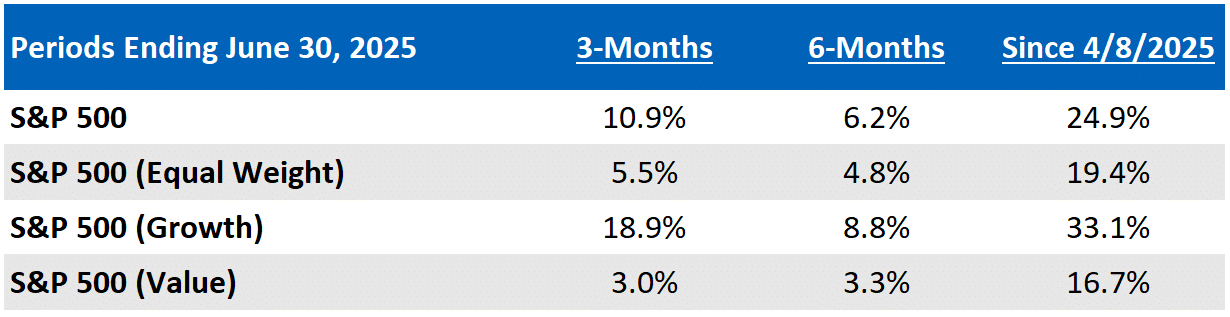
After the S&P 500 Index (S&P 500) closed at an all-time high (ATH) on February 19 (its 60th ATH since the beginning of 2024 and 3rd of 2025), stocks plummeted with the S&P 500 entering “correction” territory (down > 10%) on March 13 (just 16 trading days later) and briefly entered a tariff-induced “bear market” (down > 20%) on April 7 (intra-day low).
The Wall Street Journal (WSJ) headline summed up the first quarter misery, moaning “U.S. Stocks Post Worst Quarter Since 2022 on Threat of Trade War.” It got even worse after “Liberation Day” (April 2) with the WSJ headline blaring “Trump’s Tariffs Wipe Out Over $6 Trillion On Wall Street in Epic Two-Day Rout,” as U.S. stocks had their worst week since the March 2020 Covid-induced carnage.
Indeed, as of April 8 the S&P 500 was off to one of its worst starts to a year in history, down 15.3% since the end of 2024. Looking at the first 66 trading days of the year going all the way back to 1928, only 1932 (-20.4%), 1939 (-18.9%) and 2020 (-17.6%) were worse. To put the frightening start of 2025 in perspective, the 1932 and 1939 declines were both during the Great Depression and the 2020 plunge during a global pandemic, so that’s some pretty scary company!
Similarly, Hartford Funds examined the ten worst 2-day declines for the S&P 500 and subsequent recoveries. The “Trump Tariff Fallout” 2-day (April 3-4) decline of -10.5% was the fifth largest and trailed only those experienced during the 1987 Market Crash (-24.6% and -16.2%), 2020 COVID-19 Pandemic (-13.9%) and 2008 Global Financial Crisis (-12.4%).

Some people hate roller coasters. Unfortunately for some, market plunges and the accompanying uncertainty and frightening headlines can scare them into transforming from long-term investors (who understand short-term volatility is the price you pay for letting the “Miracle of Compound Interest” create long-term wealth) to short-term speculators (selling stocks to avoid additional pain and “waiting until the dust settles” to reinvest).

As we now know, following the April low the S&P 500 would stage an epic recovery, posting the tenth biggest 12-week S&P 500 total return gain in history. Not only did the S&P 500 recover all of the ground lost in the swoon, by June 30 it had posted its fifth ATH of 2025. On cue, the WSJ headline trumpeted “Breakneck Rebound For S&P 500 Sends Index to New High.”


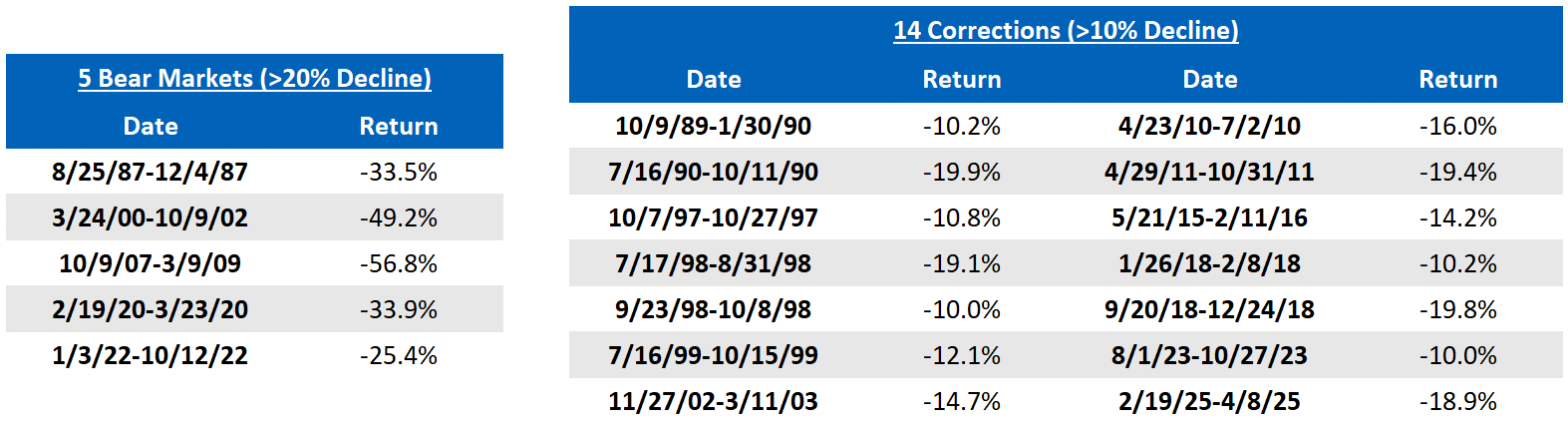
Referring back to the study from Hartford Funds, if you invested $10,000 in the S&P 500 on December 31, 1986 and simply left it alone, you would have ended up with $581,677 by June 30, 2025. According to the aforementioned “Miracle of Compound Interest” and related “Rule of 72,” you would have doubled your investment every 6 ½ years (72/11.12% average annual return for period = 6.5). The rub is only those with the fortitude to stick to their plan and “stay on the roller coaster” through not only all ten worst 2-day declines, but five harrowing “Bear Markets” and fourteen “Corrections” during the period reaped the rewards. According to Crandall-Pierce, going back to 1945 the S&P 500 has experienced 41 “Bear Markets” or “Corrections,” or one or the other every 2.0 years. While the recent “Near-Bear Market” was definitely unpleasant, it was also certainly unexceptional.
As our friend Jay Mooreland, CFP of the Behavioral Finance Network says, “selling during scary and uncertain times usually is referred to as ‘getting to safety.’ While getting to safety provides an immediate psychological benefit, it often results in a very real financial cost. Next time you feel the need to ‘get to safety’ perhaps it can be re-framed as ‘reducing my future return.’ Because no one sells and gets back in at the bottom. The only way to participate in all the gains of the market is to ride out all the temporary losses that come along the way.”
Stocks are at an ATH, but nobody knows if the storm has passed or if we’re merely in the “eye of the hurricane.” Jay recently published some sage advice.
The Upside of Low Expectations
We all strive for favorable outcomes such as financial security, peace of mind and evidence of progress. Naturally, we tend to approach situations with high expectations, especially when the stakes feel personal. But in many areas of life, dialing down our expectations can be a surprisingly effective way to boost our well-being.
Disappointment and Delight
Disappointment sets in when reality doesn’t meet our expectations. If we anticipate smooth sailing but hit turbulence—be it in travel, relationships, or markets—we’re more likely to feel frustrated or discouraged. By contrast, expecting challenges (like long airport lines or traffic delays) helps us stay grounded and reduces emotional friction when “life happens.”
On the flip side, delight often comes when reality exceeds expectations. When we assume a situation will be difficult, but it turns out better than anticipated, we experience a welcome boost of satisfaction. Managing expectations isn’t about pessimism; it’s about making room for more moments of pleasant surprise.
It’s especially helpful to assess how much influence we have in a given situation. When we have control, setting high standards can be motivating. But when outcomes are uncertain or outside our control, modest expectations are more realistic and less likely to result in disappointment.
Framing Investment Expectations
Investors often hope for strong returns with minimal bumps along the way. That’s understandable. But there’s a difference between our investment hopes and our investment expectations.
If we expect smooth performance and steady growth, we’re setting ourselves up for frustration when markets fluctuate wildly, as they have done these past several months. But if we expect the journey to be bumpy and, at times undesirable, we’ll be less rattled when “markets happen.”
In investing, the healthiest mindset tends to be one of long-term confidence paired with short-term humility. We can believe in the resilience of the market over time while still acknowledging that the path forward may be uneven, noisy, and full of surprises. During those times, please lean on us! We are here to listen, guide and ensure we stay on the right path to achieve your goals.
Summary
Investors face many significant challenges today, including the unresolved tariff/trade war, our nation’s rapidly deteriorating fiscal position and continuing global conflicts. We’ve always had to deal with serious challenges. We can’t predict the future—nobody can. Even if you could, you don’t know how the markets will react. For instance, if you knew the U.S. would initiate a global trade war in early April and join Israel in bombing Iran in late June, you probably wouldn’t want to be invested during the second quarter, which would have been a major mistake. Each crisis can feel like the end of the world when it happens, but our experience over our now more than fifty years in business has been despite the uncertainty and pain, markets have eventually bounced back.
In other words, by investing in stocks, you also bought a ticket to ride the roller coaster, so buckle up!
Spotlight Stock—AutoZone, Inc. (NYSE: AZO)
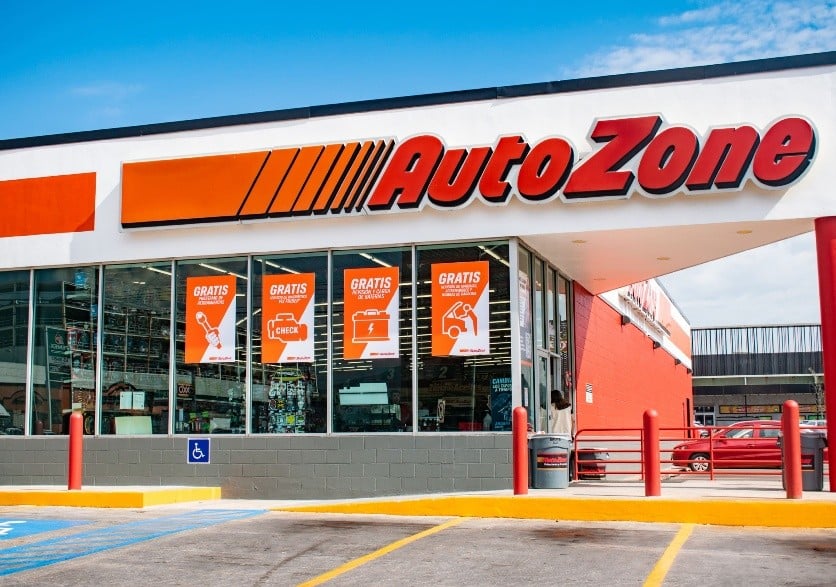
The first “Auto Shack” store (later rebranded to “AutoZone” to avoid a 1987 trademark suit from Radio Shack) was originally founded on Independence Day 1979 in Arkansas by J.R. “Pitt” Hyde III. Hyde was a third-generation grocer and early Wal-Mart board member who saw car parts retail as fertile ground to employ similar principles he picked up from his experience in grocery retail – (1) tight cost control, (2) spotless stores, and (3) excellent customer service.
AutoZone has a dominant market position we see our nation’s aging vehicle fleet as a secular tailwind. AutoZone sells auto parts to both Retail (“Do-It-Yourself” or “DIY”—about 75% of sales) and Commercial customers such as auto repair shops (about 25% of sales). AutoZone commands a roughly 13% share of the Retail market, compared with O’Reilly (ORLY) at about 9% and Advance Auto Parts (AAP) about 5%. On the Commercial side, Genuine Auto Parts (“NAPA”–GPC) has a market share of about 4-5% and AutoZone about 2-3%. At the beginning of 2025, the average U.S. light vehicle age reached an all-time high of 12.6 years, more than twice as old as in 1975. With most new vehicle warranties expiring after three years, the vehicle owner must continually spend to maintain the vehicle.
AutoZone’s sales can be segmented into three categories based on the urgency and necessity of the part being purchased; 1) failure/repair, 2) maintenance and 3) discretionary. The first two categories account for more than 80% of sales, which means AutoZone’s business is fairly recession-resistant and AutoZone’s customers are primarily concerned with AutoZone being able to supply the correct part in a timely manner (not the cheapest price).
Because of this need for speed, AutoZone is investing heavily to increase the number of “mega-hubs” that supply stores from the current 119 to eventually around 300.
Mike Petry, CFA, CAIA Joins KM as Director of Research

Kirr, Marbach’s investment approach is highly research-intensive. Mike has earned the prestigious designation as a Chartered Financial Analyst (CFA) and is a seasoned investment professional. Mike will work alongside Mark Foster, CFA, KM’s Chief Investment Officer. We are confident he will be a great addition to our Investment Team.
Mike was most recently an Equity Strategy Portfolio Manager with Old National Bank, responsible for the firm’s Dividend Equity Strategy. Prior to that, he was a Staff Accountant with SS&C Technologies. He earned double B.S. degrees in Finance and Economics from the University of Southern Indiana.
Regards,
Kirr, Marbach & Company, LLC
Past performance is not a guarantee of future results.
The S&P 500 Index is an unmanaged, capitalization-weighted index generally representative of the U.S. market for large capitalization stocks. This index cannot be invested in directly.
The S&P 500 Value and Growth Indices are sub-indices of the S&P 500 Index whose constituents are determined on the ratios of book value, earnings and sales to price. These indices cannot be invested in directly.
The equal-weight S&P 500 Index is an unmanaged, equally-weighted index generally representative of the U.S. market for large capitalization stocks. This index cannot be invested in directly.