
Wall Street predictions are worthless, so here’s mine
Mickey Kim / January 24, 2025
The following is an excerpt from Kirr, Marbach & Co.’s fourth quarter client letter, available here.
Just like in 2023 (and almost all years, for that matter), the stock market in 2024 defied the predictions and prognostications of highly-paid Wall Street strategists and other soothsayers and “experts.” I believe it’s impossible to accurately forecast markets and/or the economy, so making predictions is a waste of time.
For example, the table below lists 2024 year-end price targets (from Bloomberg) for the Standard & Poor’s 500 Index (S&P 500—ended 2023 at 4,770). As shown, JP Morgan had the most pessimistic target (4,200, or a decline of 11.9%). In fact, four of these oracles forecast a decline for the S&P 500 in 2024. The average or “consensus” target was 4,861, or a minimal gain of 1.9%. Yardeni Research had the most optimistic target (5,400, a gain of 13.2%). The S&P 500 closed 2024 at 5,882 (up 23.3%), 21% above the average target and 8.9% above even the most bullish prediction.
Last year was not an outlier. In fact, Bespoke determined “consensus” annual targets missed by an average of 14.2 percentage points going back to 2000.
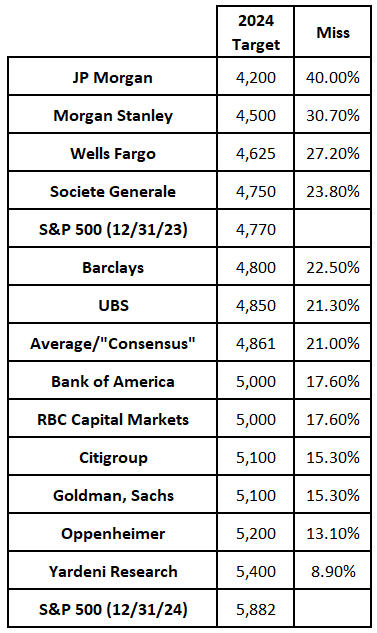
In spite of their dismal record, “experts” predict and many investors pay attention. Don’t be one of them! Heeding “expert” predictions can be extremely dangerous and costly; such predictions should be considered “for entertainment purposes only.”
That said, I do have a “non-forecast” for 2025, which is nearly identical to my previous “non-forecasts.”
- The economy/financial markets will do something that surprises us (and the “experts”).
- In 2020, it was the Covid pandemic.
- In 2022, it was Russia’s invasion of Ukraine
- In 2023, it was the collapse of Silicon Valley Bank, the second largest in history.
- In 2025, NOBODY knows what it will be.
- The financial media will enrich themselves by emotionalizing headlines and short-term market moves to entice you to click and tune in. It’s nothing more than click bait.
- Investors who tune into the news and evaluate their performance often will experience more stress and anxiety than those that don’t.
- Investing in the stock market will be unpleasant at times. Historically, the stock market goes down roughly half the time on a daily basis.
- Since 1900, U.S. stocks have experienced 40(!) “corrections” (drops of > 10%) and “bear markets” (drops > 20%), or one every 3.12 years.
- Investors that move to cash, waiting for a “better time,” will suffer significant uncertainty and anxiety about when and how to get back in.
- According to Crandall-Pierce, if you invested $100 in the S&P 500 on January 1, 1975 and left it alone, on December 31, 2024 (fifty years later), you would have had $8,578.81.
- However, if you allowed yourself to get scared out of stocks and missed just the single best day in each of the fifty years, you would have had only $1,464.65, or 83% less.
- As Charlie Munger, Warren Buffett’s right-hand man and “architect” of Berkshire-Hathaway’s investment philosophy said, “the big money isn’t in the buying or selling, but in the waiting.”
- Your investment decisions and reactions to market events will have a significant impact on your personal investment return.
- You will be tempted to change your investment strategy based on market performance, expert forecasts and/or your personal beliefs about the future.
- According to Crandall-Pierce, if you invested $100 in the S&P 500 on January 1, 1975 and left it alone, on December 31, 2024 (fifty years later), you would have had $8,578.81.
Conviction, patience, and discipline are virtues every investor should develop. Warren Buffett has described successful investing as “simple, but not easy.” You must try to ignore the noise and focus on what really matters to your financial success.
The opinions expressed in these articles are those of the author as of the date the article was published. These opinions have not been updated or supplemented and may not reflect the author’s views today. The information provided in these articles are not intended to be a forecast of future events, a guarantee of future results and do not provide information reasonably sufficient upon which to base an investment decision and should not be considered a recommendation to purchase or sell any particular stock or other investment.