


“Liberation Day” marked death of era of globalization
Mickey Kim / April 18, 2025
The following is an excerpt from Kirr, Marbach & Co.’s first quarter client letter, available here.
On April 3, 1948, President Harry Truman signed the Economic Assistance Act, better known as the Marshall Plan, (Secretary of State George Marshall proposed the U.S. provide assistance to restore the economic infrastructure of post-World War II Europe) into law. Truman said, “the signing of this act is a momentous occasion in the world’s quest for enduring peace.”
The benefits of the Marshall Plan for the U.S. were 1) rebuilding markets for American goods, 2) creating reliable trading partners and 3) development of stable democratic governments in Western Europe.
The seeds of the second great age of globalization were sown with the fall of the Berlin Wall on November 9, 1989. With the end of the Cold War, the world benefitted from a global “peace dividend” giving countries an opportunity to look far beyond traditional borders.
In a pre-Thanksgiving radio address (on why we should be thankful for trade), President Ronald Reagan said, “our peaceful trading partners are not our enemies; they are our allies. We should beware of the demagogs who are ready to declare a trade war against our friends—weakening our economy, our national security, and the entire free world—all while cynically waving the American flag. The expansion of the international economy is not a foreign invasion; it is an American triumph, one we worked hard to achieve, and something central to our vision of a peaceful and prosperous world of freedom.”
It wasn’t perfect. Many countries imposed tariffs or other barriers on U.S. exports, but the U.S. economy still prospered and was universally envied. Being recognized as the undisputed leader of the free world resulted in extraordinary privileges. The U.S. dollar has been the world’s dominant “reserve currency,” a status earned by being backed by a strong economy and stable political environment. Importantly, our trading partners were willing to fund our government’s ever-increasing budget deficits by investing export dollars in U.S. government debt.
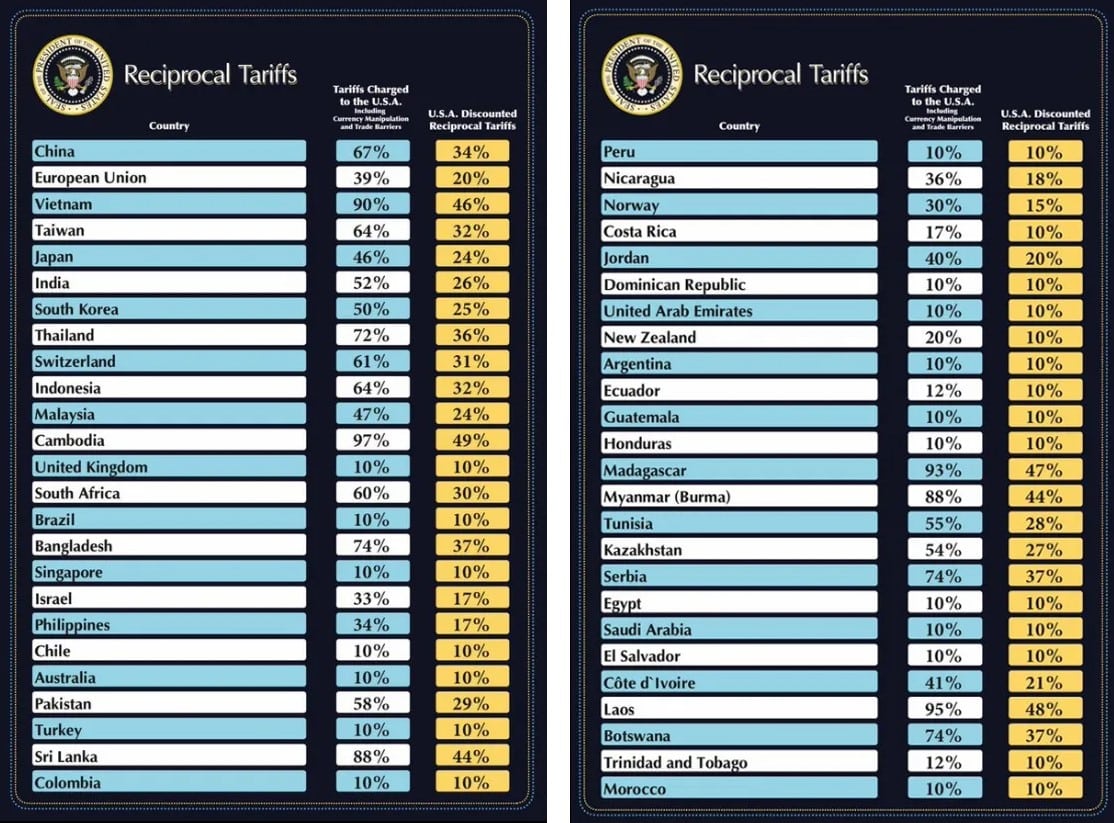
On “Liberation Day” (April 2, 2025—ironically 76 years and 364 days after Truman signed the Marshall Plan), President Trump announced a new trade regime where the U.S. would focus on its own best interests.
The magnitude of the “reciprocal” tariffs was stunning and the underlying logic puzzling. The U.S. imports and exports goods (physical products) and services, but these tariffs considered only goods. The U.S. imported $439 billion of Chinese goods in 2024 and exported $144 billion, leading to a goods-trade deficit of $295 billion. According to the Office of the U.S. Trade Representative, the entire $295 billion trade deficit can be attributed to Chinese tariffs or other non-tariff trade barriers, a dubious assumption. The “reciprocal” tariff formula took the $295 billion deficit and divided it by $439 billion of Chinese goods imported, to arrive at a “reciprocal” tariff rate of 67% (“kindly” discounted by 50% to arrive at the announced tariff rate of 34%).
“Reciprocal” tariff is actually a misnomer, as the calculation simplistically considered only the amount of the deficit, not actual Chinese tariffs. According to President Trump, any trade deficit is akin to “losing,” so there’s no need to acknowledge a country can have a “comparative advantage” enabling it to produce certain good or service at a lower cost than the U.S.. According to economic theory, when trading partners are free to produce the goods each does best, both partners benefit.
The conservative The Wall Street Journal (WSJ) wrote in an editorial “Trump’s New Protectionist Age—Blowing up the world trading system has consequences that the President isn’t advertising,” referred to the tariffs unveiled on imports from allies (24% on Japan, 20% on the European Union) and adversaries (34% on China) alike as “another large step toward a new old era of trade protectionism. Assuming the policy sticks—and we hope it doesn’t—the effort amounts to an attempt to remake the U.S. economy and the world trading system.”
The WSJ cited “consequences already emerging in this new protectionist age:”
- New economic risks and uncertainty. Will our trading partners try to negotiate to reduce tariffs, or will there be widespread retaliation (increased tariffs on U.S. exports) leading to a devastating trade war?
- Another risk lurking is the U.S. government is dependent on debtholders “rolling over” maturing bonds by buying newly issued bonds. China holds about $759 billion of U.S. government debt, making it the second largest foreign holder (behind Japan). If China refuses to buy new bonds, who will fill the void and at what price?
- Harm to American exports. 41% of S&P 500 firms’ revenues come from abroad.
- The end of U. economic leadership. “U.S. leadership and the decision to spread free trade produced seven decades of mostly rising prosperity at home and abroad.”
- A major opportunity for China. S. tariffs will give China the opening to use its giant market to woo American allies into its economic and geopolitical orbit.
- In closing, “this is far from a comprehensive list, but we offer them as food for thought as Mr. Trump builds his new protectionist world. Remaking the world economy has large consequences, and they may not all add up to what Mr. Trump advertises as a new ‘golden age.’”
We didn’t have to wait long for China’s response, as hours later it announced its own 34% “reciprocal” tariff on all American imports. The response from investors was swift and severe, with the WSJ blaring “Trump’s Tariffs Wipe Out Over $6 Trillion on Wall Street in Epic Two-Day Rout.”
The opinions expressed in these articles are those of the author as of the date the article was published. These opinions have not been updated or supplemented and may not reflect the author’s views today. The information provided in these articles are not intended to be a forecast of future events, a guarantee of future results and do not provide information reasonably sufficient upon which to base an investment decision and should not be considered a recommendation to purchase or sell any particular stock or other investment.