
Is AI frenzy a replay of late ‘90s “dot-com” bubble?
Mickey Kim / June 26, 2026
The stock market has a knack for déjà vu. Watching artificial intelligence (AI) stocks soar, it’s hard not to think back to the late 1990s, when anything with “dot-com” in its name could double overnight.
This raises the obvious question: “Is this another bubble?”
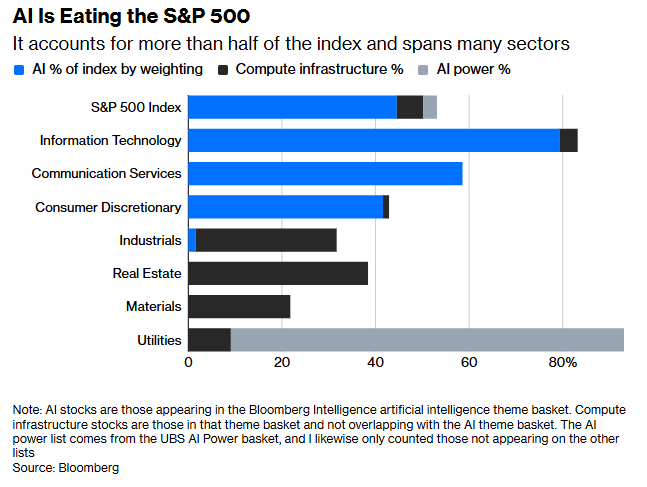
The answer matters. According to Bloomberg Intelligence, companies tied to AI now account for over half of the S&P 500’s weighting. As I noted in my February 27 column, “High concentration and low persistence: a toxic combination for investors,” many Americans hold the bulk of their financial assets in 401(k)s or IRAs that are heavily invested in S&P 500 index funds. Most investors still think of the S&P 500 as a broadly diversified portfolio representing the U.S. stock market. In reality, it increasingly behaves like a concentrated bet on a handful of large technology companies, fueled by enthusiasm for AI.
When the dot-com bubble burst in 2000, portfolios-and investor confidence-were damaged for years. So, it’s worth asking whether history is repeating itself.
Howard Marks, the co-founder of Oaktree Capital and one of the investment world’s clearest thinkers, devoted his December 2025 memo “Is It a Bubble?” to that question.
Marks argues that bubbles aren’t caused by technology itself, but by investors applying excessive optimism-what former Fed Chair Alan Greenspan famously called “irrational exuberance”-to genuine technological developments.
The pattern is consistent. A revolutionary innovation emerges. Early investors enjoy spectacular gains. Onlookers feel envy and regret that eventually morph into fear of missing out (FOMO). Speculators buy in “without knowledge of what the future will bring or concern about whether the price they’re paying can possibly be expected to produce a reasonable return with a tolerable amount of risk.”
As Marks observed, “Memories are short, and prudence and natural risk aversion are no match for the dream of getting rich on the back of a revolutionary technology that ‘everyone knows’ will change the world.”
He also notes that such “inflection bubbles” can accelerate technological progress. AI adoption, by some measures, has been far faster than previous transformative technologies like the internet and cell phones, compressing into a few years what might otherwise have taken decades.
If investors remained patient, prudent and analytical, transformative technologies might take decades to develop fully. Instead, the bubble accelerates investment-with some capital backing world-changing winners, but a lot of it being incinerated.”
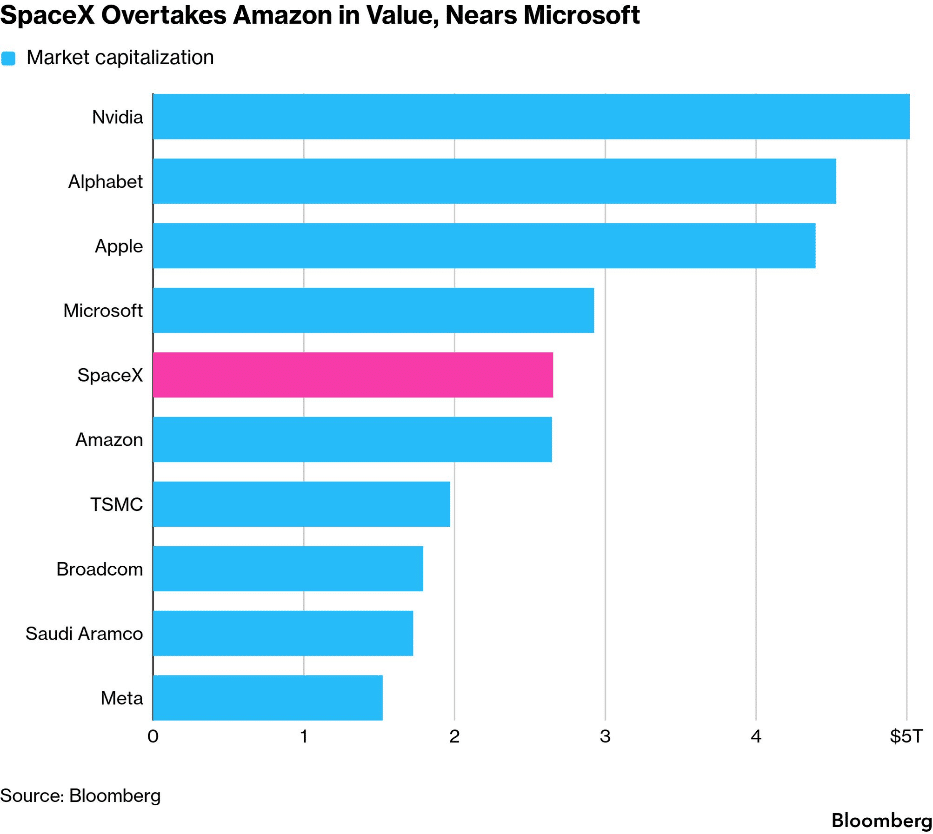
Enthusiasm for anything connected to AI remains intense. Capital is flooding the space with a “gold rush” mentality. Wall Street has long said: “when the ducks are quacking, feed them!” Trillionaire Elon Musk’s recent SpaceX IPO, while not purely an AI play, raised a record $75 billion, roughly three times more than Saudi Aramco’s offering, previously the largest IPO in history. With a market capitalization approaching $3 trillion, SpaceX trails only Nvidia, Alphabet, Apple and Microsoft in value and is ahead of Amazon.
The valuation looks even more striking when compared with the fundamentals. During the past year, Amazon generated $91 billion of net income on $743 billion of revenue, while Microsoft earned $125 billion in net income on $318 billion of revenue. SpaceX, by comparison, lost $9 billion on $19 billion of revenue.
However, before assuming a catastrophic crash is inevitable, investors should recognize several important differences between today’s AI boom and the dot-com era. The speculative fringes look familiar, but the core foundation of this market is vastly different-and much stronger.
First, earnings now matter. During the dot-com bubble, many companies were valued based on website traffic rather than profits. In early 2000, technology companies represented about 35% of the S&P 500’s market capitalization while generating only 13% of its earnings. Today, technology companies account for roughly 40% of market value but produce more than 26% of the S&P 500’s income. The dominant technology firms are among the most profitable businesses in history.
Second, the dot-com era was marked by a speculative infrastructure buildout that proved premature, at best. Telecom companies overbuilt fiber optic networks that sat largely unused for years. In contrast, demand for AI-related infrastructure remains in chronically short supply. Semiconductor shortages persist and data-center construction struggles to keep pace with actual customer demand.
Finally, revenues are already surging. The internet boom was largely funded by speculative capital hoping demand would eventually materialize. Anthropic and OpenAI, both expected to have mega-IPOs before the end of 2026, have revenue run-rates in the tens of billions.
Equally important, much of the projected $1 trillion AI infrastructure buildout is being funded from the fortress-like balance sheets and cash flows of highly profitable companies, rather than through excessive borrowing.
So, is AI a dangerous bubble?
Marks offers a pragmatic view: “Since no one can say definitively whether this is a bubble, I’d advise that no one should go all-in without acknowledging that they face the risk of ruin if things go badly. But by the same token, no one should stay all-out and risk missing out on one of the great technological steps forward. A moderate position, applied with selectivity and prudence, seems like the best approach.”
The key is maintaining perspective and discipline rather than letting enthusiasm—or fear—drive decisions.
The opinions expressed in these articles are those of the author as of the date the article was published. These opinions have not been updated or supplemented and may not reflect the author’s views today. The information provided in these articles are not intended to be a forecast of future events, a guarantee of future results and do not provide information reasonably sufficient upon which to base an investment decision and should not be considered a recommendation to purchase or sell any particular stock or other investment.