


Columnist’s final wish was to help others “get going”
Mickey Kim / November 20, 2026
What would you do if your doctor told you that you had just 12 months to live?
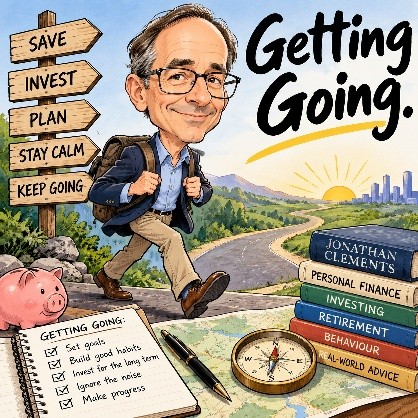
Jonathan Clements was the personal-finance columnist for The Wall Street Journal from 1994 to 2008 and again from 2014 to 2015. His “Getting Going” column ran 1,104 times. Talk about longevity!
In May 2024, Clements-healthy and fit at 61-was told he had a rare, untreatable form of lung cancer. His friends were devastated and scrambled to find a way to honor his legacy and life’s work. Some suggested a journalism award, but Clements was never about chasing fame or fortune-he was laser-focused on safeguarding the best financial interests of his readers.
Knowing his time was short, he wanted his “last hurrah” to focus on helping young people from low-income families who have never invested. He wanted to encourage them to “get going” as lifelong savers and investors by educating them and helping them open Roth IRAs.
Jonathan’s friends brainstormed a way to turn his final wish into reality: an anthology of his Journal columns titled “The Best of Jonathan Clements: Classic Columns on Money and Life.” Clements curated the 62-column collection, with book royalties funding his new Jonathan Clements Getting Going on Savings Initiative.
That mission gives this anthology a purpose beyond preserving great journalism—it allows Clements’ final investment lesson to keep working long after his death in September 2025, at age 62.
What makes this initiative so fitting is that Clements wasn’t trying to outperform the market one last time. He was trying to change someone’s starting line. He understood that the greatest advantage in investing isn’t finding the next great stock—it’s simply getting started early. For young people from families with little experience investing, opening that first Roth IRA can alter the trajectory of an entire lifetime. That’s a remarkable legacy for someone who spent three decades teaching that small decisions, repeated consistently, produce extraordinary results.
Clements quietly taught readers how to make better decisions, live with fewer regrets and understand that money is ultimately a tool—not the destination.
That perspective was why Clements became one of the most trusted voices in personal finance. He earned readers’ confidence not through flashy predictions or market-beating strategies, but through humility, common sense and an unwavering belief that ordinary people could build remarkable financial lives through steady, sensible choices.
These columns still feel current because Clements understood that personal finance isn’t primarily about math—it’s about behavior. We know we should save more, spend less and avoid emotional decisions. The difficult part isn’t understanding those principles–it’s living them.
As Warren Buffett said, “investing is simple, but not easy.”
One of the book’s recurring messages is that successful investing is intentionally boring. His advice rejected the financial industry’s endless appetite for complexity. Instead, simply allow time and the “miracle of compound interest”—not cleverness—to do the heavy lifting.
That message carries particular weight today. We are constantly bombarded with newspaper headlines and television sound bites misleading us to believe that successful investing requires perpetual action.
His writing also rejects the false notion that money exists simply to accumulate. Throughout these columns, readers encounter a broader philosophy: financial independence creates choices. Money becomes valuable because of the freedom it provides rather than the status it signals.
Perhaps that explains why Clements’ work resonates far beyond balance sheets. His columns frequently wandered into questions of happiness, relationships, generosity and purpose. He understood that financial planning divorced from life’s larger goals becomes an empty exercise. Readers are gently encouraged to ask not only, “How much do I need?” but also, “What kind of life am I trying to build?”
Clements penned more than a thousand columns, yet confided he had actually only written a couple dozen. What he meant was there are a handful of timeless investing truths, but the trick is repackaging, rephrasing, retelling and refreshing each of them in a way that makes them seem relevant, timely and topical. I’m fifteen plus years into writing this column (though this is only #297), so I understand exactly what he meant.
Clements shared the vision behind the initiative with his close friend and Journal successor, Jason Zweig:
“If you have a young person in your life, you know that one of the greatest gifts you can give is to get them started investing. They might not have a lot of money, but they have a lot of time. If you can get someone started in the financial markets at a young age, the payoff is potentially huge.
“In middle-class households, it’s easy to be comfortable with the idea of becoming an investor, but in less-affluent homes it’s not part of the daily discourse. The stock market seems like an alien entity they don’t have anything to do with and maybe never will.
“For a large part of the population, there’s nobody helping them get started as investors.
“With any luck this project can change that for them.”
For a man who spent three decades telling readers to “get going” and start investing early, there’s no more fitting last word.
The opinions expressed in these articles are those of the author as of the date the article was published. These opinions have not been updated or supplemented and may not reflect the author’s views today. The information provided in these articles are not intended to be a forecast of future events, a guarantee of future results and do not provide information reasonably sufficient upon which to base an investment decision and should not be considered a recommendation to purchase or sell any particular stock or other investment.