
“Walk like Messi” to win investing World Cup
Mickey Kim / July 24, 2026
With the United States hosting the FIFA (Federation Internationale de Football Association) World Cup 2026, interest in soccer has skyrocketed. FIFA tracks every player’s movement using arrays of high-resolution cameras mounted throughout each stadium, producing detailed physical and tactical performance data.
Many consider Argentina’s Lionel Messi to be the “GOAT” (Greatest-of-All-Time) soccer player—he holds World Cup records for goals (21) and assists (12). It’s stunning to learn that according to FIFA player-tracking data, of the 618 non-goalkeepers competing in the “group” round, Messi ranked #618 (dead last) in distance covered per 90 minutes, at just over 5 miles.
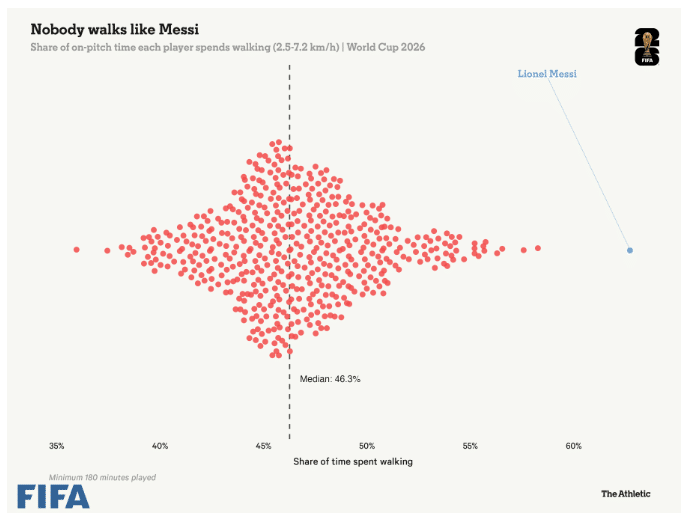
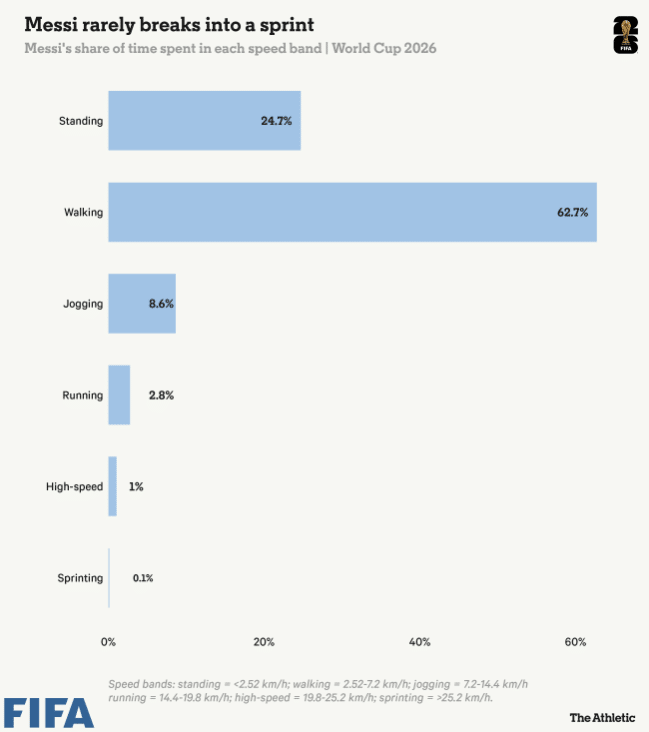
Further, according to a fascinating article in The Athletic, walking has accounted for 63 percent of his movement across the World Cup, far more than any other player and the median of 46.3%. Combined with the 25 percent of the time he is standing still, 88 percent of the time Messi looks more like someone strolling through an Indiana farmers’ market than competing in the world’s biggest sporting event
Sports analytics uses data, statistical analysis, technology and predictive modeling to improve decisions. It transforms raw information—such as player movements, game events, biometric measurements and historical performance—into insights that lead to more informed decisions.
Coaches always preach that success in sports comes from relentless effort. Keep moving. Keep pressing. Keep running. The player who covers the most ground is presumed to be the hardest worker and, by extension, the most valuable. The World Cup is played on a “pitch” 33% larger than an NFL field and able to fit about 16 NBA courts, so conventional wisdom holds that elite endurance is essential to greatness in soccer.
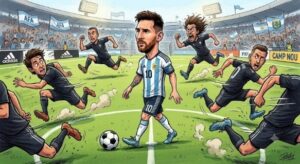
At 39, Messi is competing in his sixth World Cup—ancient for a transcendent attacking player. He hasn’t just recently started acting detached from the action, walking around the pitch like a disinterested observer—he’s always played this way.
Former Barcelona manager Pep Guardiola explained that when Messi appears to be walking, he’s actually scanning the defense and building a mental “map” of space and patterns. After several minutes of observation, he recognizes weak points and determines precisely where space will open. His subtle repositioning often creates passing lanes and space for teammates before he ever touches the ball.
The running that matters happens in short, decisive bursts, timed to coincide with the moment the ball can be used most effectively. A few steps, a change of pace, one touch and the entire geometry of the match changes. The ball finds him. The defense bends. A lane opens. A goalkeeper freezes. The scoreboard moves.
Messi’s genius isn’t constant movement. It’s selective movement. He patiently observes, conserves energy and waits until the expected value of acting is highest.
Investors make the same mistake coaches often do: both assume more activity leads to better results.
DALBAR’s 2026 Quantitative Analysis of Investor Behavior report tells a familiar but still uncomfortable story: investors often mistake motion for progress. They buy, sell, switch, redeem and reallocate in search of better outcomes. Unfortunately, across four decades of data the conclusion is blunt: the average investor consistently earns lower returns than their investments themselves because of poorly timed decisions.
The reason is not lack of intelligence—it is behavior. Investors chase what has worked, abandon what has recently hurt, confuse volatility with danger and mistake action with control.
That last point may be the most important.
Humans are wired to believe that activity creates results. More studying leads to better grades. More practice makes you a better musician.
So, most investors believe success requires constant decision-making. Markets become a never-ending stream of earnings reports, economic data, elections, geopolitical headlines and Fed meetings. Every wiggle seems to demand action. Doing something feels responsible. Doing nothing feels negligent.
The problem is that markets are not the SAT or a piano recital. They are complex, adaptive systems that punish unnecessary intervention. Every trade requires not just a decision, but a correct sequence of decisions: when to sell, what to buy instead, when to return and whether the timing offsets taxes, trading costs and lost compounding. The investor has to be right over and over again.
The activity that actually matters in investing usually happens before the crisis: setting an allocation, diversifying, building an emergency fund, understanding risk tolerance and deciding in advance what would justify a change. Once the plan is built, the hard work is often resisting the urge to respond.
Warren Buffett famously said the stock market is a device for transferring wealth from the impatient to the patient. Patience is uncomfortable because it requires trusting a process rather than reacting to every new headline. Messi offers an unexpected antidote. His genius reminds us inactivity and inattention are not the same thing. Walking is not quitting. Patience is not passivity.
Great investors, like great athletes, don’t maximize activity. They maximize expected value. They conserve their capital—physical or financial—until the odds are decisively in their favor. Messi doesn’t win by moving more. He wins by moving better. Investors should do the same.
The opinions expressed in these articles are those of the author as of the date the article was published. These opinions have not been updated or supplemented and may not reflect the author’s views today. The information provided in these articles are not intended to be a forecast of future events, a guarantee of future results and do not provide information reasonably sufficient upon which to base an investment decision and should not be considered a recommendation to purchase or sell any particular stock or other investment.