

Dear Clients:
We’re pleased patient investors like you were again rewarded in the third quarter of 2025, helping you make strong progress towards reaching your financial goals. This year has clearly not been a relaxing, drama-free upswing. As is often the case, investors were severely tested earlier this year and had to remain calm and keep a firm hand on the wheel.
While we don’t focus on short-term performance, we are gratified client equity portfolios delivered strong results during the first nine months of 2025–both in absolute terms and relative to benchmarks. This prosperous period has now stretched to three years and our performance continues to garner national attention.
We’re invested alongside you and are certainly enjoying the ride. One of our most important duties is managing and tempering expectations. Going forward, it would be wise to expect the stock market’s seemingly inexorable rise and string of all-time highs (“ATHs”) to be challenged as investors encounter more turbulence and volatility than they’ve had to deal with recently. For instance, we’ve started the fourth quarter with a shutdown of the federal government. Nobody knows what challenges tomorrow will bring, so be prepared!
2025 YTD Performance Highlights
| Periods Ending September 30, 2025 | 3-Months (Total Return) |
9-Months (Total Return) |
Since 4/8/2025 (Price Only) |
| S&P 500 | 8.1% | 14.8% | 34.2% |
| S&P 500 (Equal-Weight) | 4.8% | 9.9% | 24.1% |
| S&P 500 (Growth) | 9.8% | 19.5% | 45.7% |
| S&P 500 (Value) | 6.2% | 9.7% | 22.7% |
1. Total Return assumes the reinvestment of dividends in the index.
2. The S&P 500 Index is an unmanaged, capitalization-weighted index generally representative of the U.S. market for large capitalization stocks. This index cannot be invested in directly.
3. The equal-weight S&P 500 Index is an unmanaged, equally-weighted index generally representative of the U.S. market for large capitalization stocks. This index cannot be invested in directly.
4. The S&P 500 Value and Growth Indices are sub-indices of the S&P 500 Index whose constituents are determined on the ratios of book value, earnings and sales to price. These indices cannot be invested in directly.
5. Past performance is no guarantee of future results.
Reflections on 2025’s Market Volatility
Looking back to our Q2-2025 client letter, the S&P 500 Index (S&P 500) closed at an ATH on February 19 (its 60th ATH since the start of 2024)—only to enter “correction” territory (down > 10%) territory a mere 16 trading days later and subsequently slip into a tariff-induced “bear market” (down > 20%) on April 7 (intra-day low).
Front page headlines dramatized the turbulence: “U.S. Stocks Post Worst Quarter Since 2022 on Threat of Trade War” and “Trump’s Tariffs Wipe Out Over $6 Trillion On Wall Street in Epic Two-Day Rout.” By April 8, the S&P 500 was down 15.3% since the end of 2024. To put this rough beginning in perspective, it ranks among the worst starts to a year since the Great Depression and then the COVID-19 crash.
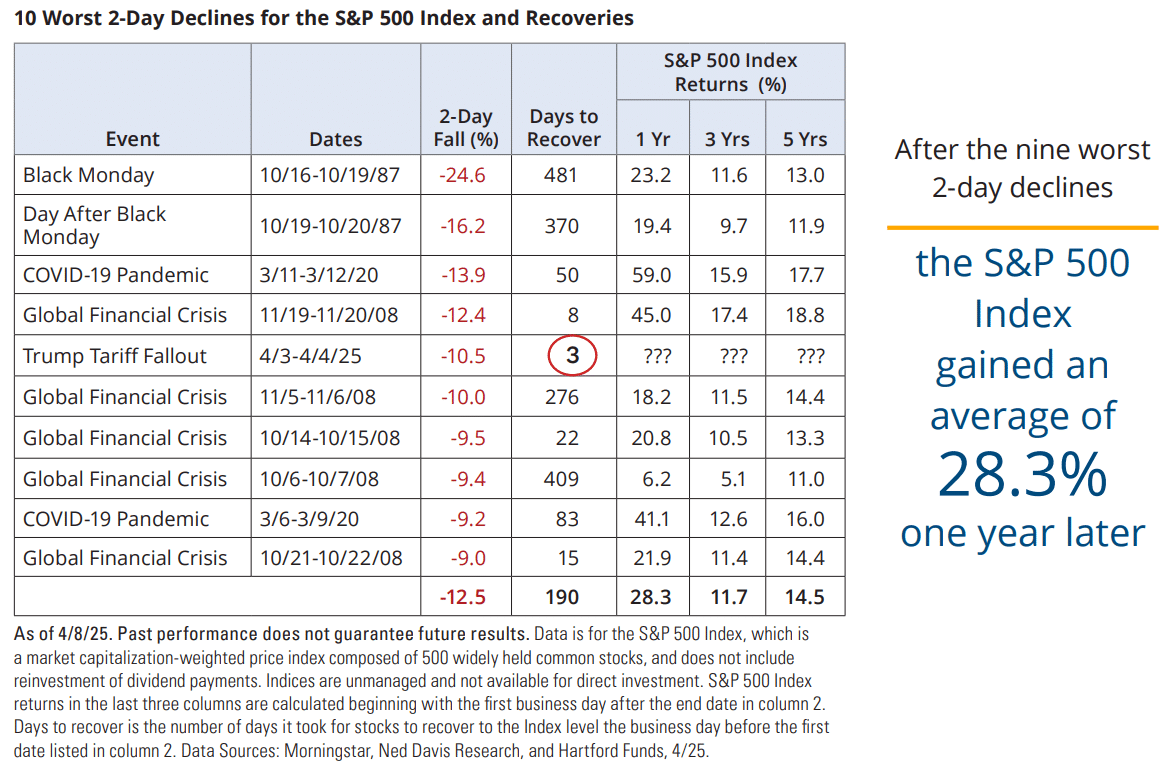
Similarly, Hartford Funds examined the ten worst 2-day declines for the S&P 500 and subsequent recoveries. The “Trump Tariff Fallout” 2-day (April 3-4) decline of -10.5% was the fifth largest and trailed only those experienced during the 1987 Market Crash (-24.6% and -16.2%), 2020 COVID-19 Pandemic (-13.9%) and 2008 Global Financial Crisis (-12.4%).
The Value of Patience: Behavioral Insights
Market plunges and the accompanying frightening headlines can tempt investors to abandon long-term plans in favor of fleeing to “safety.” Behavioral finance tells us that while this may provide temporary, short-term relief, it often comes at the cost of future returns. The only way to take part in all market gains is to endure the temporary setbacks, resisting the urge to sell during times of stress.
As our friend Jay Mooreland, CFP of the Behavioral Finance Network says, “selling during scary and uncertain times usually is referred to as ‘getting to safety.’ While getting to safety provides an immediate psychological benefit, it often results in a very real financial cost. Next time you feel the need to ‘get to safety’ perhaps it can be re-framed as ‘reducing my future return.’ Because no one sells and gets back in at the bottom. The only way to participate in all the gains of the market is to ride out all the temporary losses that come along the way.”
Remarkably, after hitting its low in April, the S&P 500 staged a record-fast rebound, fully recovering just three days after its dramatic drop, and notching its 28th ATH of the year by late September. Investors who remained patient and disciplined were richly rewarded. April 3-4 was a Thursday-Friday. Just imagine your regret had you gotten frightened enough over the weekend to sell your stocks on Monday!
Patience Is an Integral Part of the Process
Consider this wisdom:
“A gardener doesn’t control how fast a plant grows. They simply nurture the soil, provide water and trust the process.”—Shubham Kumar Singh, The Art of Detachment
Investing works much the same way. Our responsibility is to create the right environment for long-term growth—not to control outcomes, but to show up consistently and let time do its job. Patience is not passive—it’s integral to investment success.
Short-Term Volatility is the “Price of Admission” For Creating Long-Term Wealth in Stocks

Key takeaways:
- Short-term volatility and scary drawdowns are normal features of equity markets.
- Since 1980, the average intra-year decline has been 14.1%, but positive annual returns occurred in 34 of 45 years (75% of years).
- This year’s 19% drop in April felt dramatic, but such declines are not extraordinary in long-term context.
High Long-Term Returns Require Patience

Key takeaway:
- When investors hear stocks have averaged an annual return of 10.42% since 1926, it may seem a reasonable assumption stocks return 10% (within a range of 8-12%) most years. This is false. In reality, stocks have returned between 8% and 12% in only six calendar years since 1926.
- In other words, stocks almost never generate “normal,” average returns.
Stocks Have Had Higher Shorter-term Volatility and Longer-term Returns
Key takeaways:
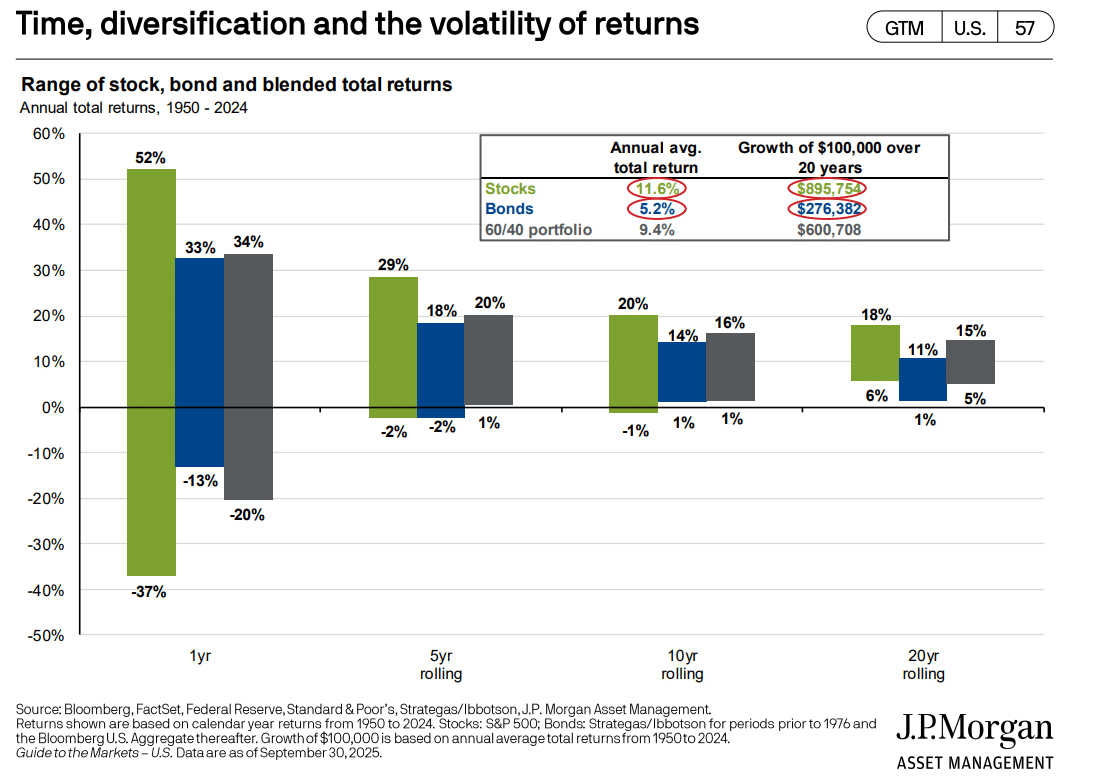
- J.P. Morgan examined calendar year returns from 1950 to 2024.
- Stocks had extremely high short-term volatility, with one-year calendar year returns ranging from 52% to -37%.
- However, over rolling 20-year periods since 1950, stocks delivered annualized returns as high as 18% and as low as 6%, smoothing out much of the short-term noise.
- Using the average annual total return of 11.6%, a hypothetical investment of $100,000 would have grown to almost $900,000.
- Bonds, though less volatile, produced much less growth—to only about $275,000 from the same starting point.
- Would you rather have a “lumpy” $900,000 with stocks or a relatively “smooth” $275,000 with bonds?
Federal Reserve Policy and Rate Cut Implications
After a nine-month pause, the Federal Reserve (“Fed”) resumed cutting rates on September 17 and signaled two additional cuts this year. Investors had been eagerly awaiting the Fed’s action for months, as history suggests rate cuts, particularly after long pauses like the one that just ended, are especially good for stocks.
According to an article in The New York Times, over the past 50 years, when the Fed has started to cut rates after taking a pause of at least six months, stocks have almost always responded positively. While there were instances when stocks declined in the first weeks after the Fed resumed cutting rates, one-year later stocks were generally higher, sometimes significantly so.
The Times referenced a report from Ned Davis Research citing seven instances since 1976 in which, after starting to lower interest rates, the Fed waited at least six months before resuming cuts. This is admittedly not a large sample size, but in all but one of these cases (i.e. 6 of 7 or 85.7% of the time), the S&P 500 rose over the following year. Further, the one-year gain for the S&P 500 for those seven instances exhibited high dispersion (range -7.2% to 47%), but the 15.5% average was significantly higher than the 10.1% average gain for all years since the start of 1976.
| January 19, 1976 | Gain of 5.5% |
| November 22, 1976 | Decline of 7.2% |
| July 20, 1982 | Gain of 47% |
| March 7, 1986 | Gain of 28.9% |
| July 13, 1990 | Gain of 3.5% |
| November 6, 2002 | Gain of 14.5% |
| July 26, 2003 | Gain of 16.3% |
For Borrowers and Savers
- Mortgage rates
- While the Fed dictates short-term interest rates, mortgage rates track longer-term U.S. Treasury yields.
- If markets believe cuts will not stoke inflation, mortgages may become more affordable.
- While the Fed dictates short-term interest rates, mortgage rates track longer-term U.S. Treasury yields.
- Credit card and prime loan rates
- The cost of consumer credit, which recently reached record highs, may ease, particularly for borrowers with strong credit.
- Savers
- Yields on savings accounts and CDs surged during the hiking cycle, giving some of the best cash returns in over a decade. Those payouts will now be stepping down as policy eases.
- This illustrates why “Cash” is not an investment.
- As yields decline, deposit income will shrink, making large cash balances less attractive. This shift is likely to push clients away from sitting on cash and toward higher-return investments.
- Yields on savings accounts and CDs surged during the hiking cycle, giving some of the best cash returns in over a decade. Those payouts will now be stepping down as policy eases.
Closing Thoughts
The last three years have been among the best for client portfolios in recent memory, but we remain vigilant. The market rewards discipline—and often humbles those who become complacent. With over 50 years of experience as a firm, we appreciate your continued trust and look forward to guiding you through changing markets and opportunities ahead.
Spotlight Stock—Broadcom Inc. (Nasdaq: AVGO)

Broadcom is a leading global technology company specializing in semiconductor and infrastructure software solutions, with its roots in high-performance chip design and enterprise software. The firm operates across two major segments: Semiconductor Solutions, which includes custom artificial intelligence (AI) accelerators, networking chips and connectivity products and Infrastructure Software.
Broadcom’s business is closely tied to the hyperscale data center boom – the wave of enormous cloud and AI data centers built by a few tech giants. Broadcom focuses on a very narrow customer base of roughly 7 mega-customers, primarily the companies developing large language models (LLMs) and other advanced AI (e.g. Alphabet/Google, Meta, ByteDance, OpenAI, Apple, Microsoft and Amazon). These “hyperscalers” have dramatically ramped up spending on massive AI training clusters, driving a “super cycle” in data center investment.
Broadcom is a critical “picks-and-shovels” supplier in this trend, providing the chips and hardware that enable extreme-scale computing. Its custom silicon and networking solutions are inside the largest AI data centers. Additionally, Broadcom’s design wins with top “hyperscalers” tend to be long-term projects (often 10+ year collaborations) that create durable revenue streams.
KM Privacy Policy Notice
In accordance with SEC Regulation S-P, we are providing our 2025 annual Privacy Policy update with this letter. To further protect your information, Kirr, Marbach & Company personnel will only release account details with your explicit authorization. Should you wish to grant access to your CPA or another service provider, please contact our Directors of Client Service, Matt Kirr (matt@kirrmar.com) or Zach Greiner, CFP® (zach@kirrmar.com), by email or at 812-376-9444 / 800-808-9444.
Regards,
Kirr, Marbach & Company, LLC
Past performance is not a guarantee of future results