


Dear Clients:
We mentioned in recent quarterly letters that midterm election years—and the September quarter in particular–have historically been challenging periods for stocks. So, we were not surprised that the “average” stock struggled during the third quarter.
You wouldn’t know it from looking only at the S&P 500 Index. Strength in a handful of mega-capitalization technology stocks enabled the capitalization-weighted index to gain 2.3% during the quarter. NVIDIA, Apple and Microsoft together represented about 21.1% of the index, despite accounting for just three of its 500 constituents, and gained 14.1%, 15.1% and 37.5%, respectively. Their strength masked considerable weakness beneath the surface: as of September 30, about 46% of the S&P 500 constituents were actually down for the year.
The S&P 500 (Equal-Weight), which assigns the same 0.2% weight to every constituent, provides a better picture of the performance of the “average” large-cap stock. It declined 1.9% during the quarter. According to Bespoke Investment Group, September was only the eighth month since 1990 in which the equal-weight index trailed the capitalization-weighted S&P 500 by more than four percentage points. Historically, periods of unusually large equal-weight underperformance have often been followed by stronger overall returns and improved relative performance of the equal-weight index, although past patterns are no guarantee of future results.
2026 Performance Highlights
| Periods Ending June 30, 2026 (Total Return) | 3-Months | 9-Months | 12-Months |
| S&P 500 | 2.3% | 12.7% | 15.7% |
| S&P 500 (Equal-Weight) | -1.9% | 10.0% | 11.5% |
| S&P 500 (Growth) | 3.4% | 15.8% | 18.4% |
| S&P 500 (Value) | 0.9% | 9.0% | 12.5% |
1. Total Return assumes the reinvestment of dividends in the index.
2. The S&P 500 Index is an unmanaged, capitalization-weighted index generally representative of the U.S. market for large capitalization stocks. This index cannot be invested in directly.
3. The equal-weight S&P 500 Index is an unmanaged, equally-weighted index generally representative of the U.S. market for large capitalization stocks. This index cannot be invested in directly.
4. The S&P 500 Value and Growth Indices are sub-indices of the S&P 500 Index whose constituents are determined on the ratios of book value, earnings and sales to price. These indices cannot be invested in directly.
5. Past performance is no guarantee of future results.
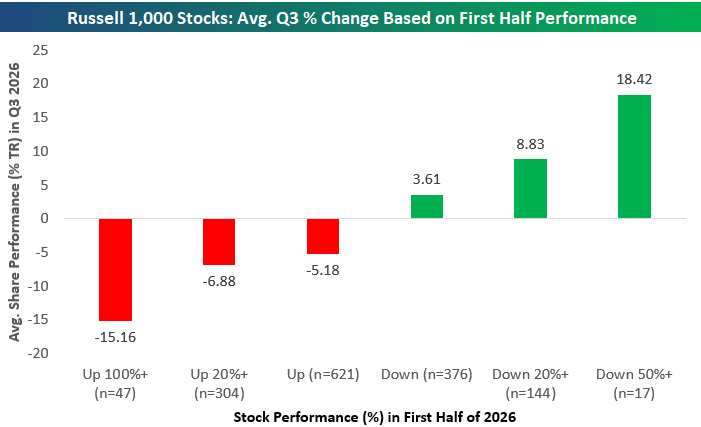
Although we were not surprised stocks struggled in the third quarter, we were perplexed by the short-term weakness in some of the stocks that had been stellar performers for us over the past three and a half years. According to Bespoke Investment Group, there was an almost perfect inverse relationship between first-half and third-quarter performance in the Russell 1000 Index. The 304 stocks that gained 20% or more in the first half fell an average of 6.9% in the third quarter, while the 144 stocks that declined 20% or more in the first half gained an average of 8.8%.
While that kind of “whiplash” isn’t enjoyable, particularly on the downside, we invest in businesses, not stock ticker symbols. Stock prices can be driven by fear and greed and can move sharply from day to day; underlying business values generally do not. The businesses we own are profitable, generate more cash than they consume and generally possess pricing power. They also generally have “clean” balance sheets with lower-than-average debt levels.
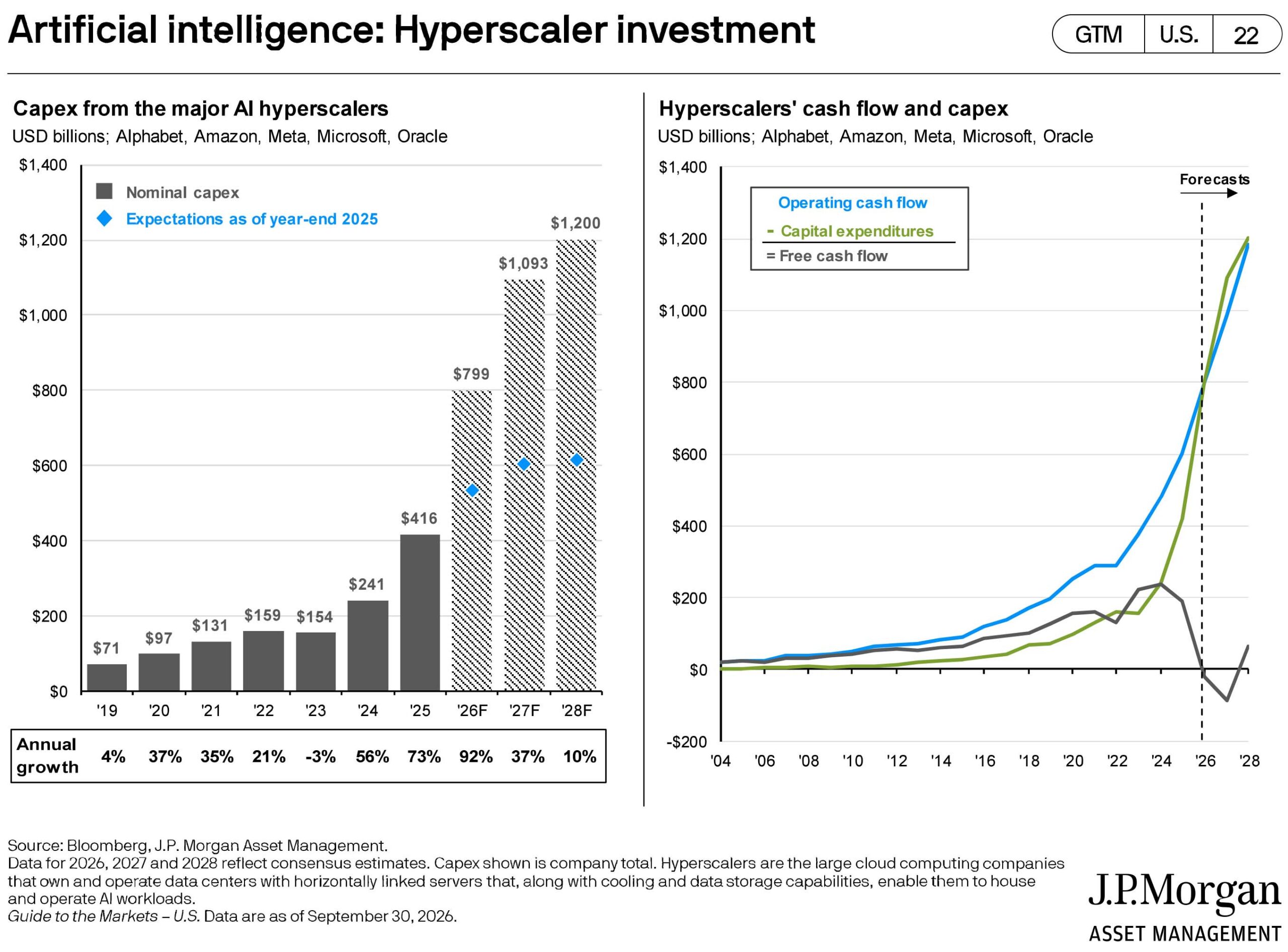
Many of our stellar performers have benefitted from the enormous capital spending by “hyperscalers” during the AI infrastructure buildout, which has been increasingly funded by massive amounts of borrowing. We would be concerned if their business prospects had faltered. They have not. In fact, our companies have significant business booked many years into the future, and the illustration below shows the scale of potential additional investment.
Will Stocks Stumble or Surge Post-Midterm Election?
We’re glad September and the third quarter are in the rearview mirror, but what lies ahead? According to CFRA, since World War II the fourth quarter (Q4) of midterm election years has historically been favorable for stocks, as election uncertainty recedes. The S&P 500 posted its second-best performance of the 16-quarter presidential cycle in those fourth quarters, rising 6.4% on average in price and advancing 85% of the time. Better yet, the following quarter–Q1 of the next year–recorded the strongest average results, gaining 7.0% and rising 90% of the time.
Guggenheim Investments examined the data somewhat differently, but reached a similar historical conclusion: “as the midterm election nears and outcomes grow clearer, uncertainty lifts and markets rebound—typically when the opposing party takes at least one house of Congress, reducing the risk of sweeping policy shifts.”
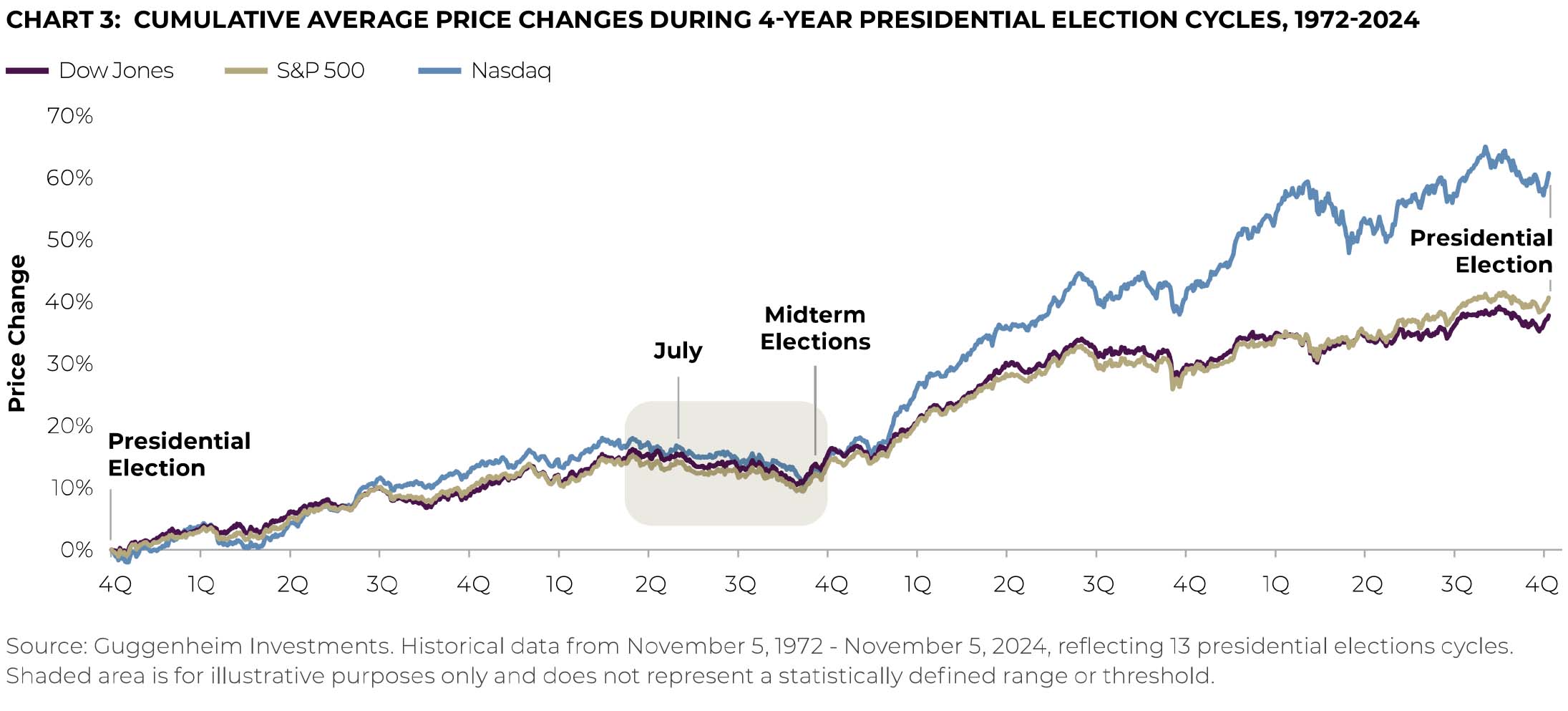
September was undoubtedly rough. History, however, provides some reason for optimism as the fourth quarter of a midterm election year gets under way.
Are the “bond vigilantes” finally riding into town?
Warren Buffett famously observed “only when the tide goes out do you discover who’s been swimming naked.”
For almost 15 years after the Global Financial Crisis, Uncle Sam enjoyed the financial equivalent of high tide—ultra-low interest rates that made borrowing trillions remarkably cheap.
The tide has gone out.
The yield on the benchmark 10-year U.S. Treasury recently surged above 5.3%, its highest level since 2002. While well below 1981’s 15.8% peak, it’s a far cry from the 0.9% at the end of 2020. The 10-year yield is arguably the world’s most important price, anchoring long-term borrowing costs for everything from home mortgages to corporate debt. The average 30-year fixed mortgage rate has jumped to 7.28%, the highest since late 2023, further squeezing an already wobbly housing market.
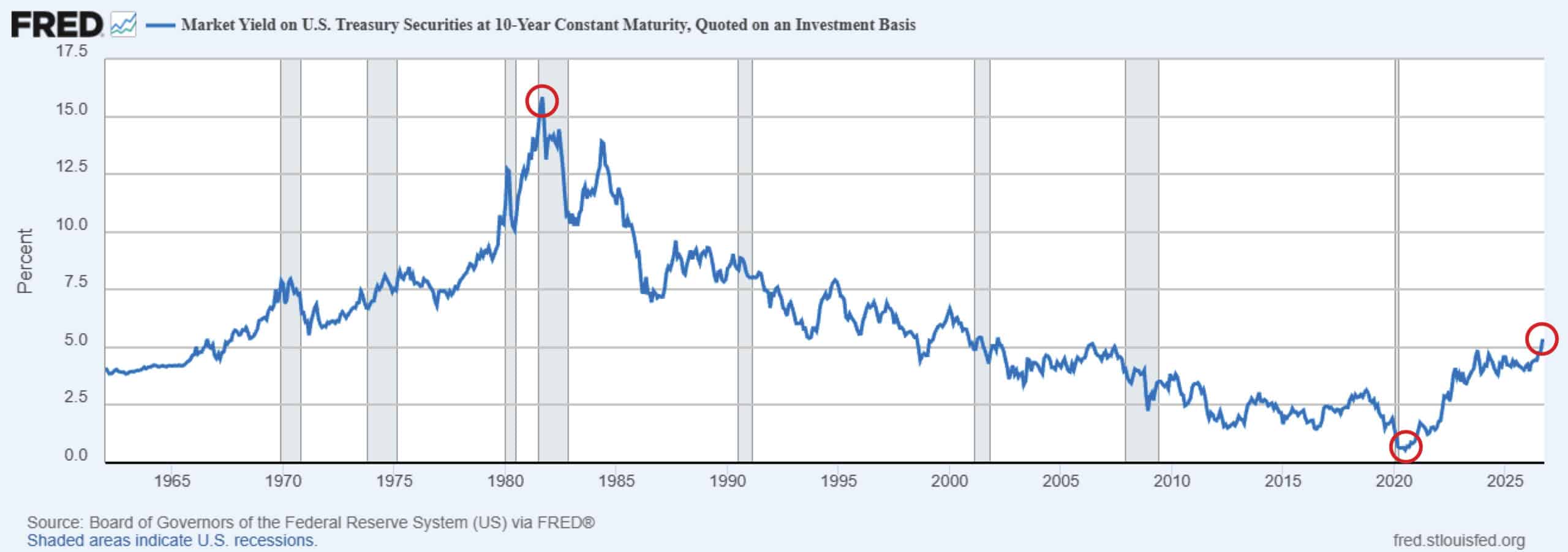
There are several plausible reasons for the surge, including stubbornly high inflation, strong economic growth, soaring oil prices due to the Iran war and expectations the Federal Reserve will have to keep monetary policy tighter than investors previously anticipated.
There is another possibility investors shouldn’t ignore: growing concern about the federal government’s fiscal trajectory.
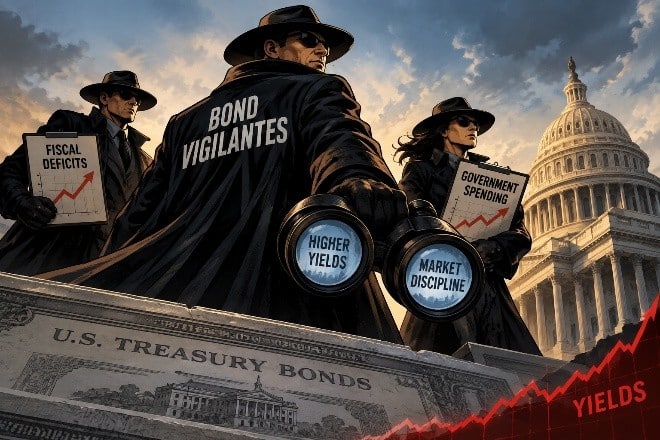
That is where the “bond vigilantes” come in. The term refers to investors who sell–or refuse to buy– a government’s bonds, driving up its borrowing costs because they view its fiscal policies as increasingly risky. There is no way to isolate how much of the recent rise in yields reflects such concerns, but the possibility deserves attention.
A lender cares about two things: getting her money back and being adequately compensated for the risk she assumes while waiting. Whether the borrower is an individual, a company or a sovereign nation, greater perceived risk–whether of default or inflation—the more compensation they will demand.
Moody’s, S&P Global Ratings and Fitch Ratings are the three primary credit-rating agencies. Moody’s stripped the United States of its top-tier rating in May 2025, following S&P in 2011 and Fitch in 2023. Moody’s cited the “failure of successive administrations and Congress to reverse large annual deficits and rising interest costs.” Treasury Secretary Scott Bessent dismissed the downgrade as a “lagging indicator.”
The fiscal trajectory is troubling. The U.S. last had budget surpluses in fiscal years 1998-2001. The Congressional Budget Office now estimates the fiscal 2026 deficit at $2.1 trillion, the seventh consecutive year of deficits above $1 trillion, as debt has ballooned past $40 trillion. Lawmakers continue to behave as if the U.S. possesses a “magic” credit card with no spending limit and a balance that never has to be repaid.
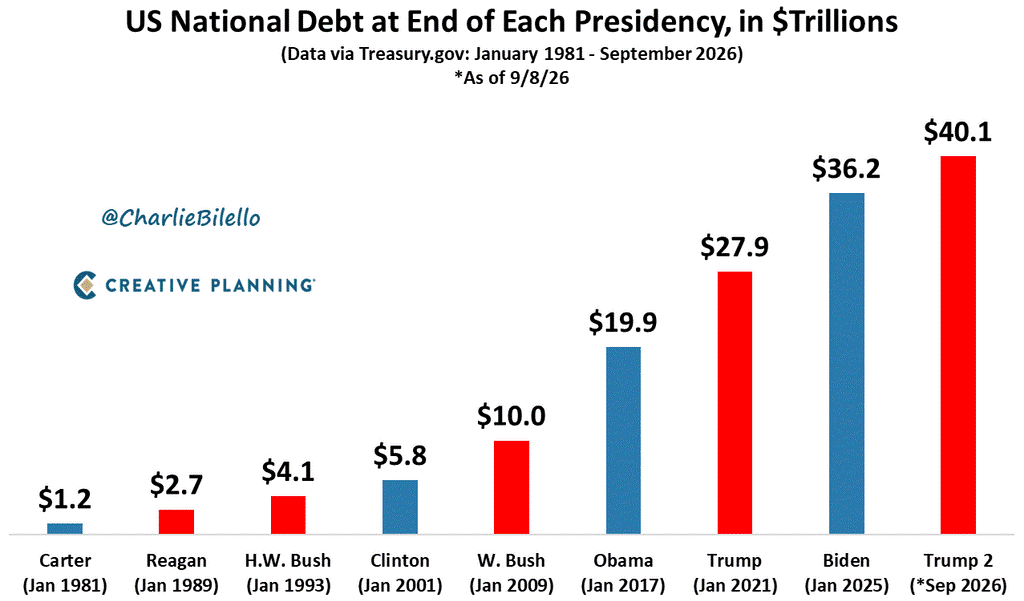
Imagine applying for a mortgage after telling the bank you routinely spend more than you earn, your credit-card balance keeps climbing and you have no plan for changing your ways. Would you expect the bank to offer you its lowest interest rate?
In August, Treasury announced it would at least double its buybacks of long-dated bonds, which pushed their prices up and yields down—for an afternoon. In September, Treasury tripled its buyback with Bessent daring traders to bet against him, proclaiming “I am the house now.” Yields still ultimately rose.
In a scathing Wall Street Journal op-ed, Stanley Druckenmiller, Bessent’s former boss at Duquesne Capital, criticized the buybacks as “price management”—an effort to suppress the long-term Treasury yield–which he called the “only fiscal disciplinarian the U.S. has left.” He argued that if investors are demanding more compensation for inflation, deficits and an expanding debt load, suppressing the bond market’s signal doesn’t eliminate the underlying problem.
Oaktree Capital co-founder Howard Marks agrees. In his September memo, “Shall We Repeal the Laws of Economics – Part III,” Marks argues that government attempts to manipulate yields without addressing the underlying causes are similar to a doctor putting an ice pack on a patient with a fever. You might lower the temperature, but you haven’t cured the illness.
For decades, the dollar’s status as the world’s dominant reserve currency has given Washington tremendous borrowing capacity.
But “tremendous” and “unlimited” aren’t the same thing.
Former Indiana Gov. Mitch Daniels was blunt during our fireside chat at Kirr, Marbach’s 50th Anniversary client event in 2025, calling the debt we’re dumping on future generations a “sad failure of our democracy.” Druckenmiller labels it “generational theft.”
“Democracies die by spending themselves broke,” Daniels said. “There has never been an empire in history that survived after spending more on debt service than on its national security, which is where we are. We’re on track to break the promises of our safety net programs, an unacceptable default of our responsibility.”
“I’m optimistic because we’re going to have a crisis. I mean a real one,” he added. “But I believe this country will come out with a completely different formula and emerge after a lot of hardship better than before.”
Bond vigilantes don’t have to organize or issue demands. They simply have to decide that yesterday’s interest rate is no longer enough. Washington needs what they possess—the money required to finance its promises.
And lenders eventually get a vote.
Spotlight Stock—Generac Holdings (NYSE:GNRC)

Generac Holdings is a leading provider of backup and distributed power solutions, best known for its dominant position in North American residential standby generators. The company generated approximately $4.2 billion of revenue in 2025, with residential products representing its largest business and commercial & industrial (C&I) products comprising most of the remainder. Increasingly, Generac is evolving from a weather-sensitive residential generator manufacturer into a broader power-infrastructure company serving homes, businesses and data centers.
The core residential franchise is attractive because Generac combines strong brand recognition with an extensive dealer and installer network that would be difficult for competitors to replicate. Long-term demand should benefit from aging electrical infrastructure, extreme weather, rising electricity consumption and consumers’ increasing dependence on reliable power. Residential penetration also remains relatively low, providing a potentially long runway for growth. The principal drawback is cyclicality: major storms and outages stimulate generator demand, while periods of mild weather can cause substantial fluctuations in sales.
The most important emerging growth driver is data centers.
Rapid AI infrastructure investment is creating enormous demand for reliable backup power. Generac has expanded into large-megawatt generators and has secured hyperscale customers, with data-center backlog reaching approximately $1.6 billion by mid-2026. Amazon alone has committed $2.4 billion in 2027-2028, with the potential to expand to $8 billion over the next five years. This opportunity could materially diversify Generac away from residential demand and turn C&I into a much larger portion of the company. C&I sales have been growing rapidly this year, driven largely by data-center deployments.
Generac also offers longer-term optionality through battery storage, microgrids, energy management and distributed-energy technologies. As electricity generation becomes more decentralized and grid capacity becomes increasingly constrained, Generac could participate in a broader market than traditional standby generation. The thesis is not without risk: residential demand remains cyclical, and the data-center opportunity introduces execution, customer-concentration and capital-spending risks that we continue to monitor.
Overall, we believe Generac offers an appealing combination of a defensible core franchise, secular growth from declining grid reliability, significant operating leverage and a potentially transformative data-center opportunity.
Regards,
Kirr, Marbach & Company, LLC
Past performance is not a guarantee of future results