Dear Clients:
U.S. stocks began 2026 on a strong note, with the S&P 500 reaching four all-time highs and peaking at 6,978.60 on January 27—approximately 2% above its 2025 closing level.
In our Q4-2025 Client Letter (January 6, 2026), we noted that three consecutive years of double-digit gains (2023-2025) is extremely rare, occurring only five times since 1928. Two streaks ended after the third year (those beginning in 2012 and 2019), two extended to a fourth year (1942 and 1949) and only one lasted five years (1995). Year Four returns ranged from +30.7% to -19.4%–an extremely wide dispersion.
Our takeaway was not predictive precision, but perspective: the 2023-2025 advance was unusual and outcomes in 2026 could diverge widely, both positively and negatively. We discussed how mid-term election years (like 2026) have been challenging for stocks and stated, “given history, a sharp and unsettling drawdown at some point in 2026 would be well within the range of normal outcomes.” Additionally, we acknowledged we are all subject to the same emotions and pointed out it is “critical to remember difficult periods are a normal part of the investment journey—not a signal to abandon your long-term plan.”
On February 28, geopolitical tensions escalated significantly when the U.S. joined Israel in military strikes against Iran. Since then, the national average price of Regular grade gasoline has soared above $4/gallon (highest since the months following Russia’s invasion of Ukraine in 2022) and the yield on the 10-year U.S. Treasury Note jumped from 4.17% to 4.43% in late March, reflecting higher inflation expectations. Heading into the last day of Q1, the S&P 500 had declined 9.1% from its January peak–just shy of the 10% threshold that defines a market “correction.” For context, the average annual peak-to-trough decline for the S&P 500 going back to 1980 has been 14.2%, so the pullback was notable, but still well within historical norms.
As shown in the table below, the S&P 500 finished the first quarter with a total return of minus 4.35%, so in a difficult, tumultuous quarter for stocks, we are pleased client equity portfolios, in aggregate, generated positive returns. Continuing a trend that began in the fourth quarter of 2025, the S&P 500 (Equal-Weight), which we believe is more representative of the performance of the “average” stock, outperformed the traditional S&P 500, where the ten largest capitalization stocks (2% of the stocks) have about a 40% index weighting.
These ten stocks had dominated the S&P 500’s three-year streak of double-digit gains, but each stumbled in Q1: Apple (-6.6%), NVIDIA (-6.5%), Microsoft (-23.5%), Amazon (-9.8%), Alphabet (-8.1%), Meta Platforms (-13.3%), Tesla (-17.3%), Broadcom (-10.6%), Berkshire Hathaway (-4.9%) and J.P. Morgan (-8.7%).
Q1-2026 Performance Highlights
| Periods Ending March 31, 2026 (Total Return) | 3-Months | 12-Months |
| S&P 500 | -4.35% | 17.77% |
| S&P 500 (Equal-Weight) | 0.65% | 12.81% |
| S&P 500 (Growth) | -8.12% | 22.62% |
| S&P 500 (Value) | 0.17% | 12.89% |
1. Total Return assumes the reinvestment of dividends in the index.
2. The S&P 500 Index is an unmanaged, capitalization-weighted index generally representative of the U.S. market for large capitalization stocks. This index cannot be invested in directly.
3. The equal-weight S&P 500 Index is an unmanaged, equally-weighted index generally representative of the U.S. market for large capitalization stocks. This index cannot be invested in directly.
4. The S&P 500 Value and Growth Indices are sub-indices of the S&P 500 Index whose constituents are determined on the ratios of book value, earnings and sales to price. These indices cannot be invested in directly.
5. Past performance is no guarantee of future results.
Heeding Buffett’s “Noah Rule”
We did not—and could not–predict this conflict. Wars, terrorist attacks and pandemics strike without warning—making preparation, not prediction, essential.
This is the essence of Buffett’s “Noah Rule,” which means you prepare before the storm by “building an ark” that protects both your portfolio and peace of mind, not after it hits.
For us, this means focusing on financially strong, resilient businesses. Additionally, we try to be vigilant about coaching and communicating with clients about the critically important behavioral aspects of successful long-term investing, in calm times and especially during stormy times (see insert with a reprint of our March 3 email to clients, “Navigating Geopolitical Uncertainty with Patience and Perspective”).
Buffett noted, “something different happens all the time. And that’s one reason economic predictions just don’t enter into our decisions. We make business predictions about what individual businesses will do over time, and we compare that to what we had to pay for them.
Buffett explained their decisions rest on business fundamentals, not short-term economic forecasts: they invest in companies—not based on what the economy might do next year—but on what those businesses can achieve over time. “The truth is, you’ve got to expect good times and bad times in business,” he said. “We’re going to have good years, bad years, in-between years and maybe a disastrous year some year. We care a lot about the price. We do not care about the next 12 months.”
Stocks are not just ticker symbols—they represent ownership in real businesses. The key is stock prices can be extraordinarily volatile (like recently), but the underlying value of a business tends to change much more gradually. Like Buffett, we try to buy “great businesses with great managers,” who will be able to succeed during difficult times just as they would during good times.
Crises happen. We try to “build an ark” by investing in businesses that have stood the test of time and withstood economic, political and financial market calamities. We acknowledge we can’t know the future, so our goal must be to do the best possible job of investing in the absence of knowledge. In other words, navigate, don’t predict!
Military Conflicts May Rattle Markets, But Not for Long
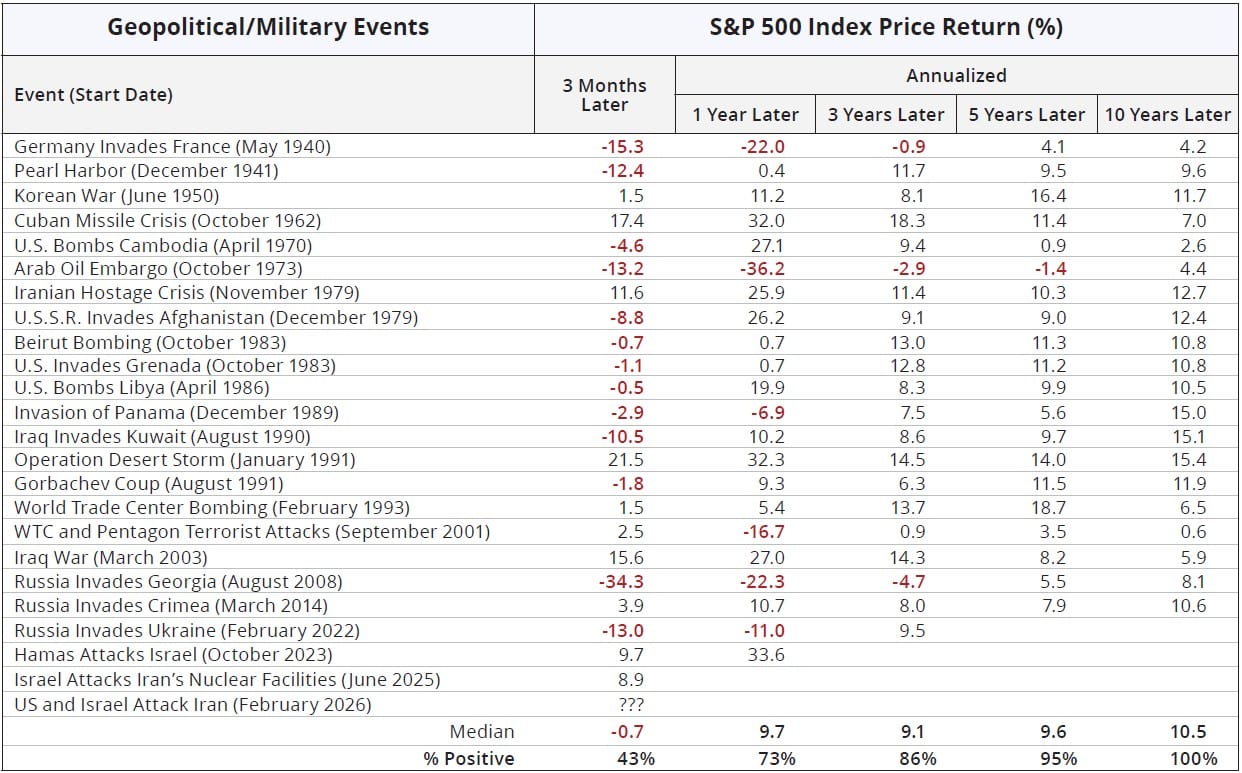
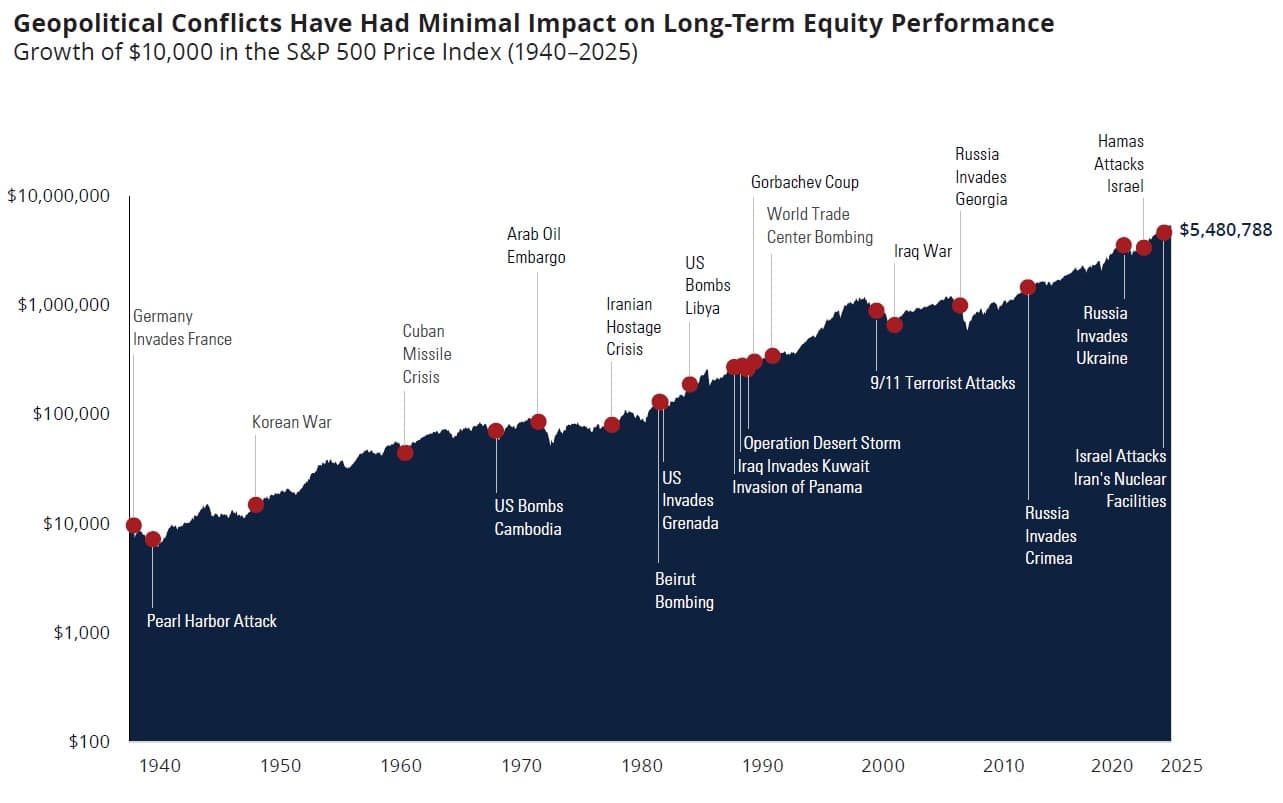
While geopolitical events feel unique and can create short-term volatility, market history offers valuable perspective. Since World War II, stocks have delivered positive returns one year after about 73% of armed conflicts. The longer the investment time frame, the more likely a positive return.
Spotlight Stock—EMCOR Group, Inc. (NYSE: EME)

EMCOR Group, Inc. illustrates the type of business we seek to own for the long-term. While some investment managers describe themselves as long-term investors yet rotate holdings frequently, our portfolio turnover has averaged around 20%, which means we typically own a stock for about five years. We first invested in EMCOR in 1995– over thirty years ago.
EMCOR is a leading U.S. specialty contractor and provides facilities services in mechanical and electrical construction and building and industrial services. Its decentralized network of local and regional subsidiaries fosters strong customer relationships and disciplined execution, while corporate provides financial strength, risk management and a rigorous safety and project‑control culture. This combination supports consistent execution on complex, mission‑critical projects and a steady expansion in higher‑margin recurring work.
Core operations span three primary areas: (1) electrical and mechanical construction for non‑residential and essential environments, including data centers, healthcare, life sciences, advanced manufacturing, public infrastructure and commercial facilities; (2) ongoing building services and facilities management, including preventive and predictive maintenance, small projects and tenant improvements, energy efficiency upgrades and remote monitoring and controls optimization; and (3) industrial services, including maintenance, turnarounds, and capital project support for refining, petrochemical, power and other process‑industry customers. This diversification reduces reliance on any single customer, industry or project type.
From an investment perspective, we believe EMCOR’s business mix offers an attractive blend of large, technically complex projects and growing annuity‑like service revenues. The company’s focus on high‑impact and technically demanding environments further raises switching costs and supports pricing power versus smaller or less specialized competitors. Finally, EMCOR represents a play on secular themes such as AI data center growth, reshoring of advanced manufacturing and increasing requirements for energy efficiency and system reliability.
Final Thought—Avoiding the Front-Page Headline Trap
Every day, there’s a new headline, typically referencing the temperature of the current rhetoric from the U.S. and Iran and often the complete opposite from the day before. It’s easy to get emotionally whipsawed.
Just looking at the headlines from consecutive days from The Wall Street Journal:
- S&P 500 Falters and Oil Rises After Hopes Fade for a Quick End to Iran Conflict (March 31, 2026)
- Stocks Cap March With ‘Hormuz Hope’ Rally on Possible End to Middle East Conflict (April 1, 2026)
It’s constant. And it’s designed to get your attention.
The problem is what makes the front page compelling almost always makes it a poor guide for investment decisions.
What the Front Page Gets Wrong
- The front page is about what just happened or what might happen next.
- Your investment plan focuses on what tends to happen over time.
- News emphasizes shock and urgency; investing rewards patience and process.
- A pullback may feel like a signal and volatility can feel like a warning that action is needed.
- Market pullbacks and volatility are not exceptions—they are a normal part of investing.
Why It Feels So Convincing
- Headlines are immediate and specific. They feel important.
- And when you see the same message repeated, it starts to feel like something you need to act on.
- But reacting to headlines often leads to short-term decisions that don’t align with long-term goals.
A Better Way to Think About It
- Don’t ignore the news—just don’t let it steer your decisions.
- Ask: “Does this change my long-term plan?” Most of the time, it doesn’t. And that’s discipline.
While the headlines change daily, our focus remains steady–owning high-quality businesses and helping clients stay disciplined across all markets.
Regards,
Kirr, Marbach & Company, LLC
Past performance is not a guarantee of future results